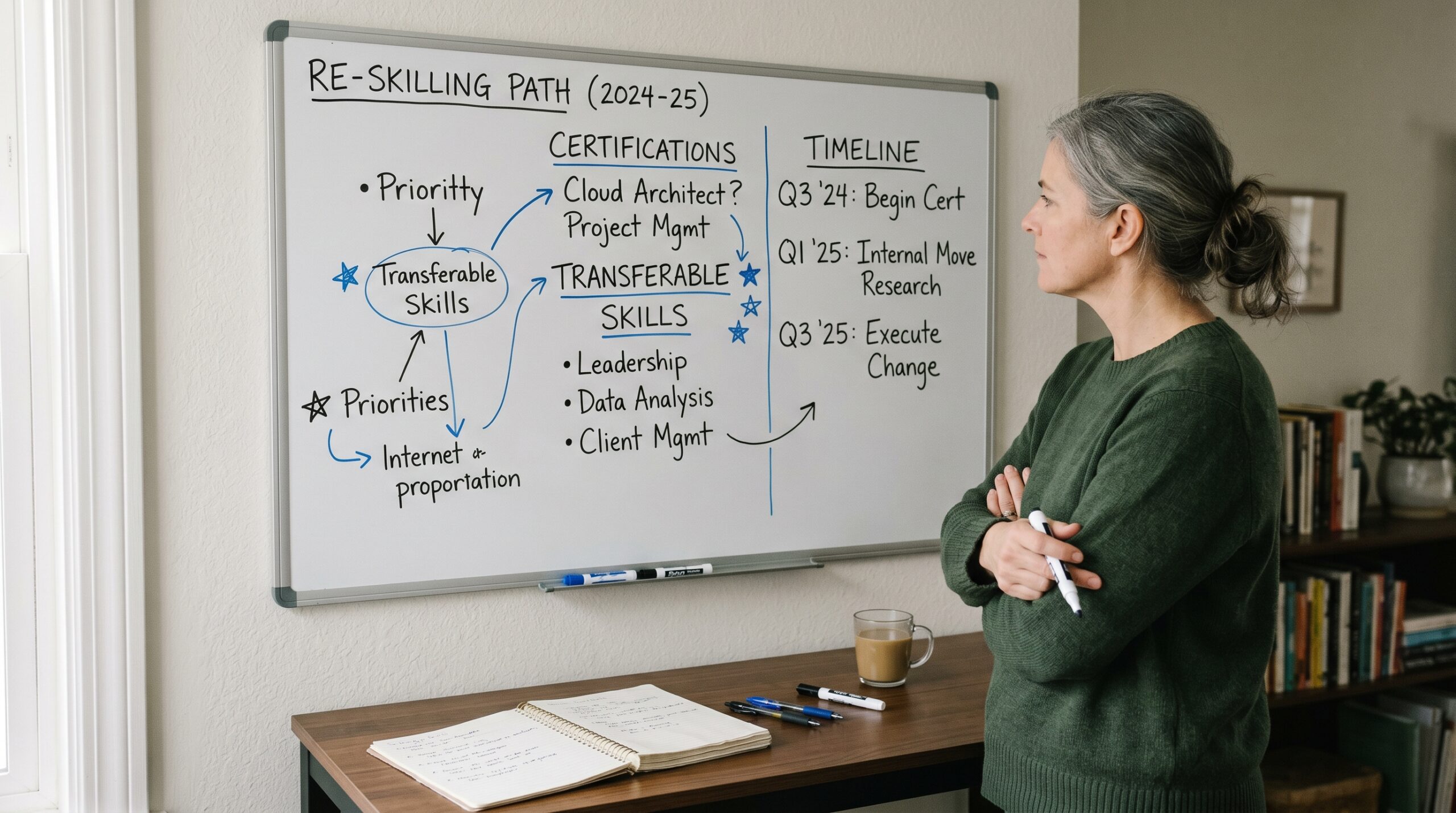
AI is reshaping work faster than any technology in history. It handles analysis, writes reports, and answers customer questions without a coffee break. For anyone over 50, watching this unfold feels less like innovation and more like the ground shifting under thirty years of hard-won expertise. That instinct isn’t paranoia. It’s pattern recognition. But here’s what the panicked takes miss: the skills that stay valuable as AI spreads aren’t the ones on the latest bootcamp syllabus. They’re the messy, human, judgment-heavy strengths you’ve been building all along—and unlike ChatGPT subscriptions, they compound with experience instead of expiring when the next version ships.
The World Economic Forum’s Future of Jobs Report and McKinsey’s AI workforce studies agree on something rare for forecasting documents: the skills projected to grow most through 2030 aren’t technical. They’re relational, creative, ethical, and adaptive. AI is a tool for pattern-matching and speed. It cannot navigate ambiguity, build trust in a crisis, or invent something that doesn’t fit a training dataset. Humans do that. Specifically, experienced humans who have lived through enough messy situations to recognize when the pattern doesn’t apply.
This isn’t an article about pivoting into prompt engineering or learning Python at 53 unless you want to. It’s a roadmap to the seven most durable skill categories backed by real data, each with practical build steps that don’t require expensive courses or starting over. By the end, you’ll have a clear action plan to make yourself more valuable in the AI era, not by chasing the technology but by doubling down on what it can’t replicate.
Complex Problem-Solving in Ambiguous Environments
AI excels when the problem is defined, the data is clean, and the solution follows a recognizable pattern. That describes approximately 11% of the decisions you make at work. The rest involve incomplete information, shifting constraints, competing priorities, and stakeholders who can’t agree on what success looks like. Humans—especially humans who have been doing this for decades—thrive there. AI doesn’t.
A 2025 MIT supply chain case study tracked managers adapting to sudden geopolitical disruptions. AI forecasting models failed to predict the shifts because the variables were novel. Human managers with pattern-recognition experience rerouted shipments 20% faster by trusting intuition about secondary suppliers, political risk, and what their logistics partners weren’t saying on the calls. That’s not a skill you learn from a textbook. It’s what happens when you’ve solved enough messy problems to recognize the shape of a new one.
How to build it:
Keep a weekly “wicked problem” journal. Pick one real ambiguity from work—something with no clear answer—and brainstorm ten possible solutions without filtering for feasibility. Test one. Most will fail. The point isn’t brilliance. It’s building comfort with uncertainty and iteration.
Join a strategy meetup or online community like Reddit’s r/consulting where people dissect messy decisions. Read Thinking in Bets by Annie Duke. Apply the framework to one decision per week.
This skill improves through repetition, not instruction. The good news is that if you’ve been working for twenty years, you already have the raw material. You just need to notice it.
Emotional Intelligence and Relationship Navigation
AI can analyze sentiment in a Slack message. It cannot read the three-second pause before someone answers a question in a meeting, or recognize when a team is about to fracture under deadline pressure. Emotional intelligence—real-time awareness of unspoken dynamics and the ability to act on them—is rising faster than any technical skill on the World Economic Forum’s 2027-2030 demand projections.
Gallup tracked managers during 2024 AI-driven layoffs. The ones who retained top performers used one-on-one coaching to rebuild trust and reframe ambiguity as shared problem-solving. Retention improved 35% over managers who treated restructuring as a process to announce and move past. The difference wasn’t policy. It was the ability to make people feel seen in a moment when corporate communication was designed to make them feel replaceable.
This is the skill that separates competent managers from the ones people follow through chaos. AI will never do it. Humans who don’t practice it lose it.
How to build it:
Run a daily “empathy audit.” After key interactions—meetings, calls, tough emails—spend two minutes noting what you missed. What did the other person want that they didn’t say? Reframe the conversation from their perspective. Do this consistently and you start catching signals in real time instead of three hours later in the shower.
Practice active listening. In your next five calls, paraphrase what you heard three times per conversation. It feels awkward at first. It also works.
If you want structure, LinkedIn Learning offers a course called Inspiring Leadership through Emotional Intelligence. Use the free trial. Take the frameworks seriously. Apply them immediately.
Creative Synthesis and Skills That Stay Valuable as AI Spreads
AI remixes existing patterns. Humans invent by connecting ideas that have never touched before. This is creative synthesis: blending unrelated domains to generate something new. It’s not art for art’s sake. It’s a practical, high-leverage skill that separates strategic thinkers from people who execute well within established lanes.
A 2026 Deloitte study found that 40% of Fortune 500 companies had adopted ethical frameworks created by professionals who fused philosophy, law, and technology. These weren’t technologists who read a book about ethics. They were people who could operate fluently in multiple disciplines and see the gaps that specialists missed. AI can summarize philosophy papers and write policy templates. It cannot invent a framework for a problem that doesn’t have precedent.
How to build it:
Start an “idea mashup” practice. Every day, combine two random fields—gardening and data visualization, medieval history and supply chain logistics, improv comedy and financial planning—and spend ten minutes asking what happens if you apply principles from one to the other. Most combinations are useless. One in twenty produces something you can prototype.
Consume cross-discipline content deliberately. Podcasts like A Slight Change of Plans expose you to people solving problems in fields adjacent to yours. Notice the transferable patterns.
Once per quarter, prototype one mashup idea using no-code tools like Bubble, Notion, or Airtable. The goal isn’t to launch a product. It’s to prove to yourself that synthesis produces results, not just clever observations.
Ethical Judgment Under Pressure
AI follows rules. Humans weigh values in situations where the rules conflict, the data is incomplete, and every option has a tradeoff. Ethical judgment—the ability to make a defensible call when no answer is clean—is rising 28% in demand according to McKinsey’s workforce studies. This isn’t philosophy-seminar ethics. It’s the practical, high-stakes kind that happens when you have fifteen minutes to decide something that affects real people and no policy manual covers it.
Compliance officers navigating AI bias scandals in 2025 saved their firms millions not by following a checklist but by recognizing when technical compliance missed the point and reframing the response around trust and transparency. That’s judgment informed by values, not algorithms.
How to build it:
Use Harvard’s case studies for weekly ethical dilemma discussions. Pick one case. Spend twenty minutes working through the tradeoffs. If possible, do this with a peer accountability partner so you have to defend your reasoning out loud.
Role-play high-pressure scenarios where every option has a cost. Practice articulating why you chose the option you did, not just what you chose.
If you want a credential, Coursera offers a free AI for Everyone course that includes a module on AI ethics. Useful not because it teaches you what to think, but because it exposes you to the questions that matter before you’re in the middle of one at work.
Hands-On Mastery and Sensory Expertise
Most of the AI conversation assumes all valuable work happens on a screen. That’s a bias, not a forecast. Physical, tactile skills—the ones that require sensory feedback, improvisation with materials, and real-time adaptation to what’s in front of you—are not only resistant to full automation, they’re growing. Bureau of Labor Statistics data from 2026 shows artisanal trades like custom fabrication and skilled repair growing 15% year-over-year as mass production becomes commoditized and people pay premiums for work that cannot be templated.
AI can design a chair. It cannot feel the grain of the wood, adjust for a knot that showed up halfway through the cut, or recognize when a joint is going to fail under stress before the math says it will. Humans with hands-on expertise can.
This applies beyond trades. Cooks, gardeners, machinists, restorers—anyone whose work involves real-time sensory judgment and physical problem-solving is working in a domain where AI’s leverage is limited and human skill is non-fungible.
How to build it:
Dedicate five hours per week to a hands-on craft. Woodworking, welding, repair, gardening, cooking—anything where the feedback is tactile and immediate. The goal isn’t to become a master. It’s to rebuild comfort with physical problem-solving and demonstrate to yourself (and eventually to clients) that you can produce tangible results.
Join a local makerspace. Most cities have them. Membership is cheap. The peer learning is invaluable.
Document your work as a portfolio on LinkedIn. If you’re building skills in repair or custom fabrication, you’re also building proof of capability that can translate into consulting gigs, side income, or a full career pivot if you want it.
Agile Lifelong Learning
The World Economic Forum ranks learning agility—how fast you can pick up a new skill, tool, or domain—as the top meta-skill for 2027-2030. This isn’t about collecting certifications. It’s about getting comfortable with discomfort and proving to yourself that you can go from zero to functional in an unfamiliar area faster than you think.
Executives over 50 who adopted micro-learning habits—focused 30-day skill sprints on one specific tool or domain—landed AI-adjacent roles twice as fast as peers who treated learning as a background activity. The differentiator wasn’t aptitude. It was deliberate, compressed practice with fast feedback loops.
How to build it:
Run one 30-day “skill sprint” per quarter. Pick a single tool or concept—Notion AI, basic SQL, podcast editing, email automation—and commit to using it daily for thirty days. Track your progress with an app like Habitica so you have external accountability.
Teach what you learn. Write one LinkedIn post per week explaining a concept you just figured out. Teaching forces clarity. Clarity reveals gaps. Filling gaps makes the skill stick.
The meta-skill here isn’t the tool you learned. It’s proving to yourself that you can learn quickly when you focus. That confidence is what makes lifelong learning sustainable instead of exhausting.
Storytelling for Influence and Clarity
AI writes serviceable reports. Humans persuade through narrative. Storytelling—the ability to take facts, data, and recommendations and turn them into something people remember and act on—is up 22% in demand per the Edelman Trust Barometer. This isn’t creative writing. It’s strategic communication: knowing which details to include, which to omit, and how to structure the arc so the decision-maker arrives at your conclusion feeling like they thought of it themselves.
Internal communications professionals who used narrative frameworks to drive AI adoption inside their organizations saw 50% higher engagement than peers who relied on bullet points and policy memos. The difference wasn’t the content. It was the structure. Story makes abstract concepts concrete, reduces resistance, and gives people a mental model they can repeat to others.
How to build it:
Rewrite one email per week as a three-act story. Set up the problem, introduce tension or complication, resolve with a clear next step. Most business emails bury the point in paragraph four. Story structure surfaces it in sentence two.
Join Toastmasters or take a virtual improv class. Both force you to think on your feet and structure ideas clearly under pressure. That’s the skill. Everything else is polish.
Analyze three TED Talks that worked. Reverse-engineer the structure. Then try to recreate one—not the topic, the shape—in a presentation or pitch you have coming up. You’ll fail the first time. By the third attempt, you’ll notice the pattern becoming automatic.
FAQ
What if I’m starting from zero in these skills?
You’re not. If you’ve held a job for more than five years, you’ve used every skill on this list, even if you didn’t name it that way. The work here isn’t learning from scratch. It’s making implicit capability explicit and practicing it deliberately so it becomes a strength you can describe and demonstrate, not just something that happens when conditions are right.
How much time per week to see results?
Five to seven hours, split across two skills maximum. Trying to build all seven at once is a plan to build none of them. Pick the two that either feel closest to what you already do or open the most doors for where you want to go. Sprint on those for 90 days. Reassess. Add a third only when the first two are automatic.
Will these skills protect against full AI takeover?
No one knows what “full AI takeover” looks like or whether it happens. What we do know: the skills projected to stay in demand through 2030 are the ones that involve human judgment, ambiguity, relationship navigation, and creativity under constraints. If those collapse, the larger economic system collapses with them and none of this matters anyway. The better framing: these skills make you valuable in every plausible future where people still have jobs.
Best free resources for over-50 learners?
LinkedIn Learning has a free trial and lets you download course materials. Coursera offers financial aid for most certificate programs if cost is the blocker. YouTube has high-quality tutorials for nearly every hands-on skill if you can filter past the noise. The resource that matters most is peer accountability—find one other person doing the same skill sprint and check in weekly. External accountability turns intent into repetition.
How to measure progress?
Track behavior, not feelings. Don’t ask “Am I getting better at empathy?” Count how many times per week you catch an unspoken dynamic in real time and adjust for it. Don’t ask “Am I more creative?” Count how many mashup ideas you’ve prototyped. Don’t ask “Am I learning faster?” Measure how long it took to go from zero to functional on the last three tools you tried. Feelings lag behavior. Behavior produces evidence. Evidence builds confidence.
Conclusion
The skills that hold value as AI spreads aren’t the ones on the bootcamp syllabus. They’re the messy, human, judgment-heavy strengths you’ve already been building—and the ones that compound with experience instead of depreciating when the next model launches. Pick two from this list. Give them 90 days of deliberate practice. Track the behavior, not the feeling. Then reassess.
AI amplifies humans who adapt. It replaces the ones who don’t. The difference between those two isn’t age, credentials, or technical background. It’s whether you treat capability as something you earned once and defend forever, or something you build continuously because the ground keeps moving.
Here’s a 30-day challenge: pick one skill. Log your progress daily. Share it in the comments or with one peer who will ask how it’s going. Accountability turns plans into practice. Practice turns practice into proof. And proof is what opens doors when the next disruption arrives and you’re still standing.
This article is for informational purposes only and is not financial advice. Consult a qualified professional for personalized guidance.
Leave a Reply